



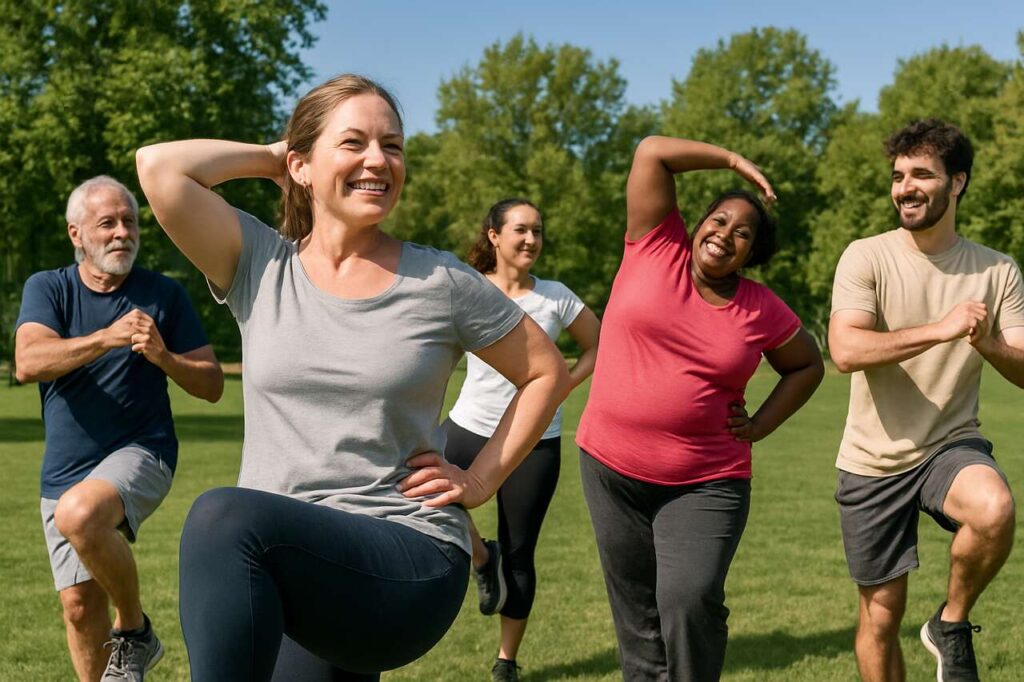
Building a robust core doesn’t require endless repetitions of traditional floor exercises. Standing exercises offer a dynamic and effective alternative that engages multiple muscle groups whilst improving stability and functional strength. These movements mirror everyday activities, making them practical for real-world applications. Whether you’re seeking to enhance athletic performance or simply wish to strengthen your midsection without lying on the floor, standing core exercises deliver impressive results. This approach proves particularly valuable for those with limited mobility, back concerns, or anyone looking to diversify their training routine.
The basics of standing exercises for core strengthening
Understanding core anatomy and function
The core encompasses far more than the visible abdominal muscles. This complex system includes deep stabilising muscles such as the transverse abdominis, multifidus, and pelvic floor, alongside the rectus abdominis, obliques, and erector spinae. Standing exercises activate these muscles in coordination, creating functional strength that translates to improved movement patterns throughout daily life.
How standing exercises engage the core
Unlike floor-based movements that provide external support, standing exercises require constant core engagement to maintain balance and stability. This anti-rotation and anti-extension work strengthens the core in multiple planes of motion. The body must continuously adjust to gravitational forces, recruiting stabilising muscles that often remain dormant during traditional crunches.
- Vertical positioning activates deep stabilisers automatically
- Balance challenges increase neural activation
- Multi-planar movements improve functional capacity
- Integration with full-body movements enhances coordination
Key principles for effective standing core work
Successful standing core training relies on controlled movement quality rather than speed or repetition count. Maintaining proper alignment throughout each exercise ensures optimal muscle recruitment whilst minimising injury risk. Focus on breathing patterns that support core engagement, typically exhaling during the exertion phase whilst maintaining abdominal tension.
These foundational concepts set the stage for understanding why certain traditional exercises may not serve everyone’s needs equally well.
Why to avoid the dreaded sit-ups
The biomechanical concerns with traditional sit-ups
Traditional sit-ups place significant compressive forces on the lumbar spine, particularly when performed with improper form. Research indicates that repeated spinal flexion under load can contribute to disc problems over time. The hip flexors often dominate the movement, reducing actual abdominal engagement and creating muscular imbalances that affect posture and movement patterns.
| Exercise type | Spinal compression force | Core activation pattern |
|---|---|---|
| Traditional sit-ups | High (3,000+ N) | Isolated, flexion-dominant |
| Standing core exercises | Low to moderate | Integrated, multi-directional |
Who should particularly avoid sit-ups
Certain populations face elevated risks from traditional sit-up protocols. Individuals with existing back conditions, disc issues, or osteoporosis should exercise particular caution. Pregnant women and those in postpartum recovery often benefit from alternatives that don’t increase intra-abdominal pressure in the same manner.
- Those with herniated or bulging discs
- People experiencing chronic lower back pain
- Individuals with diastasis recti
- Anyone with neck tension or cervical spine concerns
The functional limitations of floor-based crunches
Beyond injury concerns, sit-ups fail to replicate real-world movement demands. Daily activities rarely require spinal flexion whilst lying supine. Standing exercises better prepare the body for lifting, carrying, twisting, and stabilising during actual functional tasks, creating strength that transfers beyond the gym environment.
The advantages of vertical training extend beyond safety considerations to encompass improved stability and coordination.
Standing exercises: an ally for perfect balance
The connection between core strength and balance
Balance represents a complex interplay between the vestibular system, proprioception, and muscular control. A strong, responsive core serves as the foundation for all balanced movement. Standing core exercises simultaneously challenge and develop these systems, creating improvements that reduce fall risk and enhance athletic performance.
Proprioceptive benefits of vertical training
Proprioception—the body’s awareness of its position in space—improves dramatically through standing exercise protocols. These movements require constant micro-adjustments that sharpen neuromuscular communication. Over time, this enhanced body awareness translates to better movement quality in all activities, from walking on uneven surfaces to performing complex athletic manoeuvres.
Progressive balance challenges in standing core work
Standing exercises offer natural progression opportunities by manipulating the base of support. Beginning with bilateral stances provides stability whilst introducing core engagement. Advancing to single-leg variations dramatically increases difficulty and balance demands.
- Wide stance exercises for beginners
- Narrow stance progressions for intermediate practitioners
- Single-leg variations for advanced training
- Unstable surface work for elite development
Adding external resistance through weights creates another dimension of challenge and effectiveness.
Include dumbbells to intensify your workout
How resistance enhances core activation
Introducing dumbbells to standing core exercises creates additional stabilisation demands that amplify muscle recruitment. The core must work harder to maintain posture and alignment whilst managing external loads. This increased challenge accelerates strength development and improves the body’s capacity to handle real-world demands involving lifting and carrying.
Appropriate weight selection strategies
Choosing suitable dumbbell weights requires balancing challenge with form maintenance. Start with lighter loads that allow perfect technique throughout the entire set. As control improves, gradually increase resistance whilst preserving movement quality. The weight should challenge the target muscles without compromising spinal alignment or forcing compensatory patterns.
| Experience level | Suggested starting weight | Progression timeline |
|---|---|---|
| Beginner | 2-5 kg per hand | 2-4 weeks before increase |
| Intermediate | 5-10 kg per hand | 1-3 weeks before increase |
| Advanced | 10+ kg per hand | Variable based on goals |
Specific dumbbell exercises for standing core work
Several exercises particularly benefit from dumbbell integration. Overhead carries challenge anti-extension stability, whilst suitcase carries target anti-lateral flexion. Wood chops with weights develop rotational power and control across multiple planes.
- Single-arm overhead press for anti-lateral flexion
- Farmer’s carries for total core bracing
- Rotational chops for oblique engagement
- Single-leg deadlifts for posterior chain integration
Regardless of resistance levels, proper positioning remains paramount throughout every repetition.
The importance of posture in exercise execution
Neutral spine alignment fundamentals
Maintaining neutral spinal alignment during standing core exercises ensures optimal force distribution and muscle recruitment. This position preserves the natural curves of the spine whilst avoiding excessive flexion, extension, or rotation. Proper alignment protects vulnerable structures whilst maximising the training effect on target muscles.
Common postural faults and corrections
Several postural deviations commonly appear during standing core work. Anterior pelvic tilt often accompanies overhead movements, whilst lateral shifting occurs during unilateral exercises. Recognising and correcting these faults prevents compensation patterns and ensures training effectiveness.
- Excessive lumbar extension: engage lower abdominals and glutes
- Rounded shoulders: retract scapulae and open chest
- Forward head position: align ears over shoulders
- Locked knees: maintain slight bend for shock absorption
Breathing patterns that support core stability
Proper breathing enhances core activation rather than diminishing it. The 360-degree breathing technique—expanding the ribcage circumferentially rather than only anteriorly—maintains intra-abdominal pressure whilst allowing oxygen exchange. Exhaling during exertion phases whilst maintaining core tension creates optimal stability throughout challenging movements.
Consistent practice with proper form yields far greater benefits than sporadic intense sessions.
Following a programme focused on regularity and progression
Designing an effective standing core routine
A well-structured programme incorporates varied movement patterns that challenge the core in multiple planes. Include anti-extension exercises like overhead carries, anti-rotation movements such as pallof presses, and anti-lateral flexion work through suitcase variations. This comprehensive approach develops balanced strength across all core functions.
Frequency and volume recommendations
Standing core exercises can be performed more frequently than traditional floor work due to their lower spinal loading. Most individuals benefit from 3-5 sessions weekly, allowing adequate recovery between training days. Each session might include 4-6 exercises performed for 2-4 sets, with repetitions or time under tension appropriate to the specific movement.
| Training goal | Weekly frequency | Sets per exercise | Repetitions/duration |
|---|---|---|---|
| General fitness | 3 sessions | 2-3 sets | 10-15 reps or 30-45 seconds |
| Strength development | 4 sessions | 3-4 sets | 6-10 reps with load |
| Endurance focus | 4-5 sessions | 2-3 sets | 15-20 reps or 45-60 seconds |
Progressive overload strategies
Continuous improvement requires systematic progression. Increase difficulty through multiple variables rather than weight alone. Extend time under tension, reduce rest periods, advance to more challenging exercise variations, or manipulate stability by narrowing the base of support.
- Add repetitions before increasing weight
- Progress from bilateral to unilateral stances
- Introduce unstable surfaces gradually
- Combine movements for greater complexity
Standing core exercises provide an accessible, effective, and safe approach to developing midsection strength without traditional floor-based movements. These vertical training methods engage stabilising muscles whilst improving balance, coordination, and functional capacity. By incorporating proper posture, appropriate resistance, and progressive programming, individuals at all fitness levels can build a robust core that supports both athletic endeavours and daily activities. The elimination of high spinal compression forces makes this approach particularly valuable for those with back concerns or mobility limitations. Consistency in practice, combined with attention to movement quality and gradual progression, ensures sustainable improvements in core strength and overall physical capability.